
I’m sad to write that last week, my dad George passed away after a six-year battle with glioblastoma (GBM). For reference, the 5-year survival rate for this disease is about 5%. So, he defied the odds.
I’m sharing his story here in case it may be of benefit to some other glioblastoma patient who might stumble upon it.
I’m going to detail the things my dad did differently that may have contributed to his extended survival, as I believe they may be relevant to all patients diagnosed with “incurable cancer.”
But please note what’s detailed below is my family’s personal experience, not medical advice. Many of the therapies my dad attempted carry real risk, and no patient should attempt them on their own without consulting their oncologist.
What is glioblastoma?
A little more about glioblastoma, and how nasty this particular form of cancer really is.
GBM is universally considered a death sentence. For reference, one book written on the subject by a surgeon who treats this disease is titled I’ve Seen the End of You.
It’s a rapidly proliferating “Grade 4” (highest grade) brain tumor that grows like a weed in the hot summer sun. The tumor does not metastasize to other parts of the body. It starts as a singular tumor, and remains that way until the end.
Upon discovery, the tumor is usually resected immediately via a brain surgery, although due to a glioblastoma’s amorphous, globular shape, and its location nestled within precious brain tissue, it is not possible to resect every last cancer cell without paralyzing or killing the patient in the process.
The goal of the initial resection is to remove as much of the tumor as possible without disabling the patient. It’s assumed that some tumor cells will remain, and will quickly grow back. The surgery is meant to buy the patient some time.
Eventually, the tumor enhances to the point that the brain is squeezed and becomes swollen, and the patient dies.
How my dad survived 6 years
In my dad’s case, he had a tangerine-sized glob resected in June 2020 by Dr. Ramachandran at the Lahey Clinic in Burlington, MA. The surgery was successful, defined by there being very little cancer matter detected in the post surgical MRI, and my dad preserving all motor and speech ability upon waking.
The surgery was a perfect balance of cancer margin removed, and brain tissue preserved. We were all very grateful to Dr. Ramachandran. He hit it out of the park.
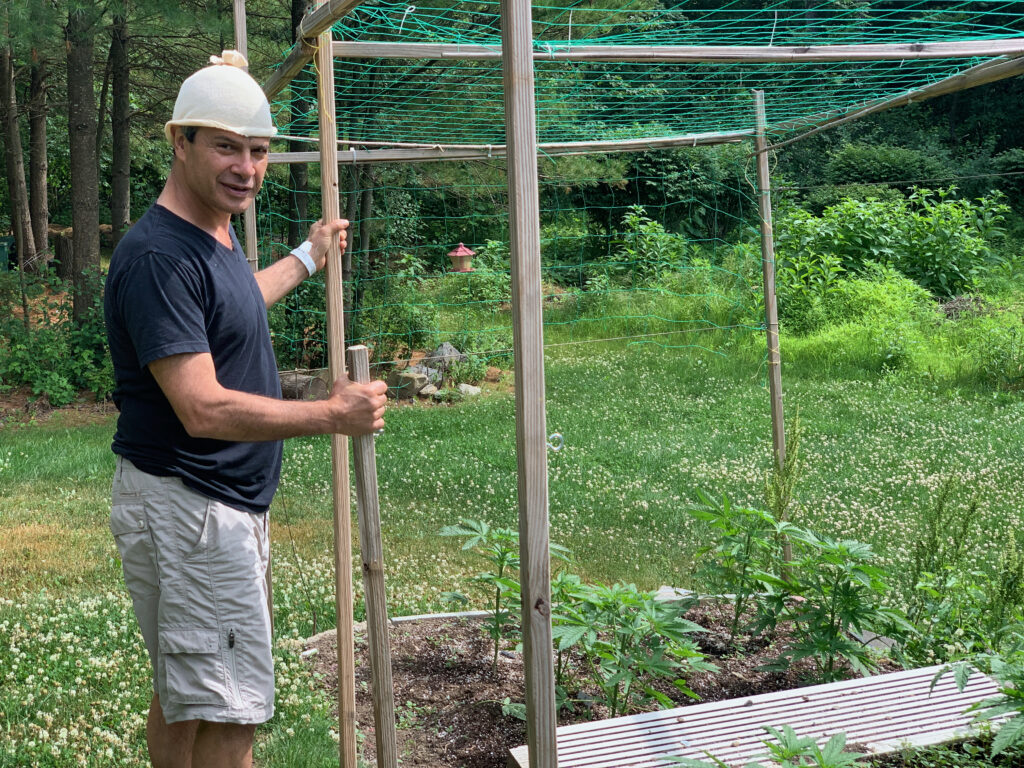
Undoubtedly, the successful tumor resection was a great start to my dad’s extended survival.
The week after the surgery, my dad met with an oncologist who gave him 9-15 months to live. He was told to begin making end of life arrangements, and to savor his remaining time with family and friends.
That very afternoon, I was tasked by my parents and siblings to crack the glioblastoma code. We were not going to settle for the conventional prognosis and treatment.
I immediately went into patient advocacy mode and scoured the internet for all resources on surviving terminal brain cancer.
Within a day, I had found three solid leads for how my dad could differentiate himself from other glioblastoma patients.
1. A strict ketogenic diet
I read that cancer eats sugar, and that abstaining from dietary carbohydrates could starve the voracious tumor of its preferred food source.
And so we resolved to get my dad on a zero sugar diet.
I discovered a European firm called Paleomedicina that specialized in an animal-based keto diet they called the Paleolithic Ketogenic Diet (PKD). They had some success stories actually treating GBM patients.
Within two weeks of his surgery, my dad was on the PKD. The diet was characterized by 1) small servings, 2) a specific ratio of animal fat to animal lean meat (more fat than you would expect), and 3) consumption of organ meats.
These instructions came right from my dad’s clinical notes from Paleomedicina:
The diet should be based on four-legged animals with a 2:1 ratio of fat:protein ratio (in grams of dry matter) which practically corresponds to eating 100 gram of meat along with 35 gram of animal fat (lard/tallow/trimmed fat/beef suet/smoked slab). Eat to your hunger and eat until satiation.
The diet should include a regular intake of organ meats from four-legged animals and should specifically include regular intake of liver (400 gram a week) and brain or bone marrow (200 gram a week).
My dad kept himself in a state of elevated ketosis day in and day out for 6 months, as demonstrated by his Keto-Mojo meter. Although he despised the diet and would often get angry during meals.
2. Hyperbaric oxygen therapy
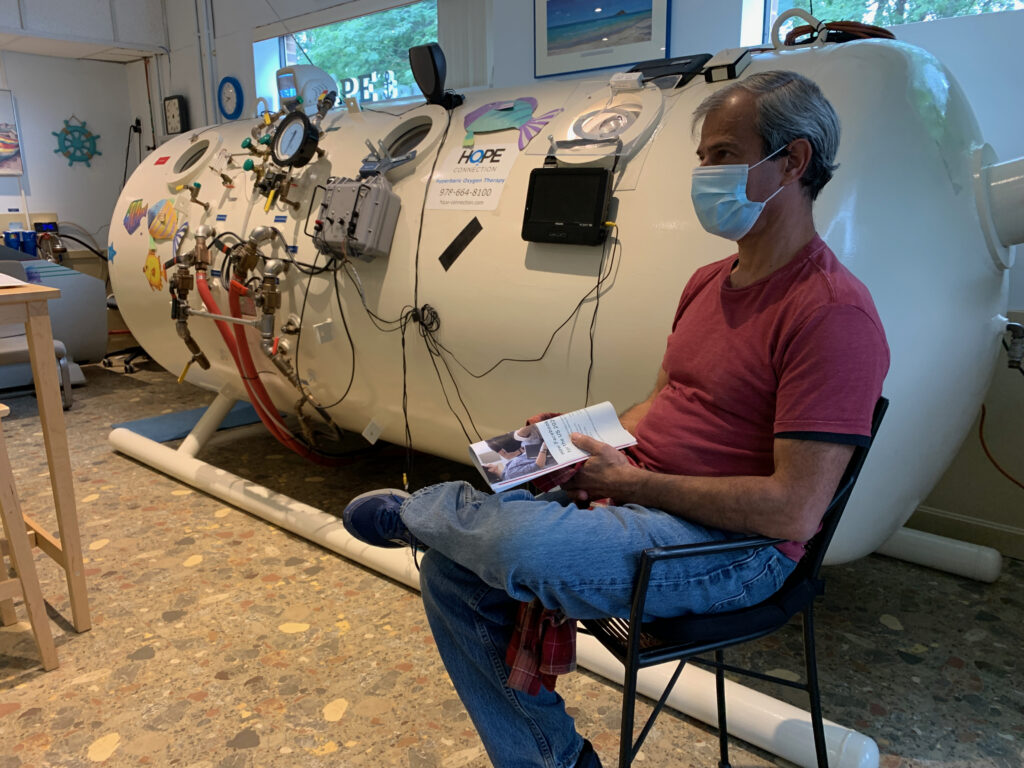
Hyperbaric oxygen therapy (HBOT) involves sitting inside a pressurized chamber and breathing oxygen through a mask. I had read that HBOT could boost my dad’s immune system in the fight against the tumor, while also mitigating the effects of radiation therapy.
We found an HBOT clinic near Boston, and my dad went 3 or 4 days a week for about a month, for the duration of his radiation therapy and slightly beyond.
3. Stacking chemo, radiation and off-label drugs
Next, we implemented the “Anti-Cancer Cocktail” strategy, which involves simultaneously stacking supplements and off-label drugs with traditional chemotherapies. The idea is to take many drugs together, each of which takes a small bite out of the cancer, but together make a large cumulative impact.
This idea is championed in the YouTube documentary Surviving Terminal Cancer, and also in Dr. Raymond Chang’s book Beyond the Magic Bullet.
Although potentially very effective, this “cancer cocktail” approach is not mainstream because lots of glioblastoma (and other cancer) treatment is trial-based, and taking too many medicines simultaneously muddies the water of the studies.
Sadly, it’s often the case that cancer treatment at major hospitals is designed for drug trial validation, and is not necessarily optimized for a given patient’s survival.
It should also be noted that many of the off-label drugs used in the Anti-Cancer Cocktail approach are older, small-molecule drugs that have expired patents and can be purchased cheaply. In other words, they are not big profit drugs.
I’m not trying to be cynical, or suggest malevolent motives by the cancer centers. I’m just stating facts, and trust me, I understand that the reason the United States produces many of the best medicines in the world is because the profit incentive is there for private companies to do so.
My dad benefited from some of these drugs, such as the chemotherapies Temodar and Avastin, and I would not want to advocate for kicking the legs out from under the system that produced them.
But, when your dad is staring death in the face, one must do what’s best for HIM. We were more concerned with my dad’s survival than with his ability to contribute to the trial data of some drug, and so we embraced the idea of the Anti-Cancer Cocktail approach and decided to throw everything but the kitchen sink at it.
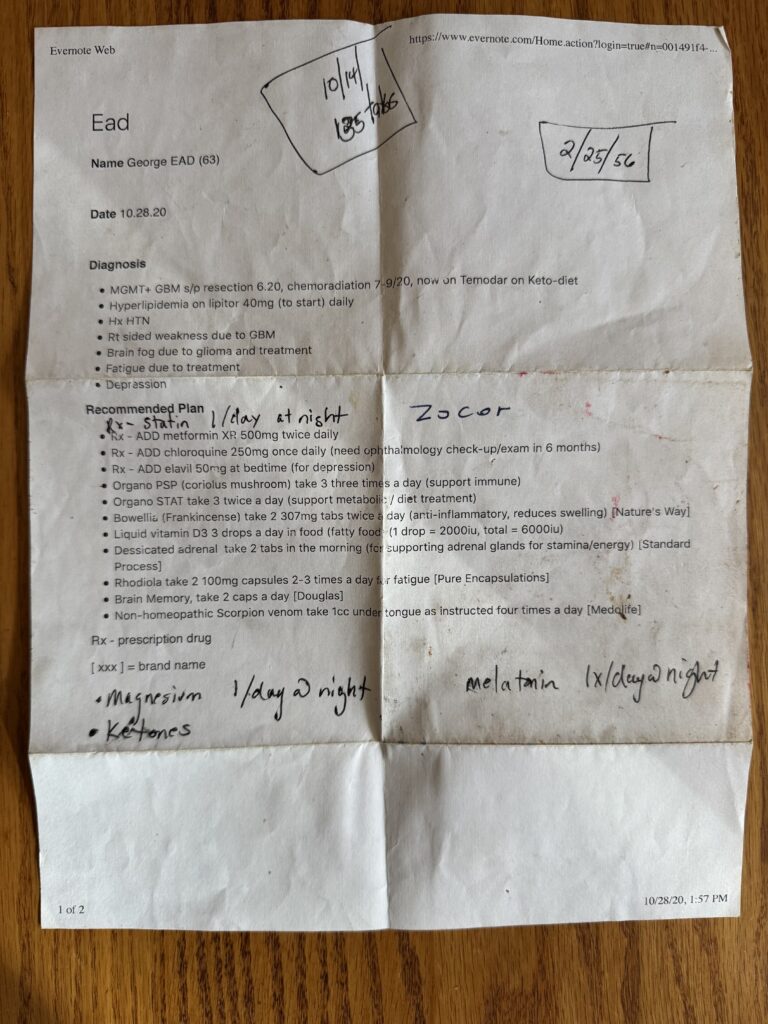
We bit the bullet and paid $1,000/hr to consult with Dr. Raymond Chang, for about 2 hours. Following that meeting, my dad was prescribed Temodar (chemotherapy), radiation, metformin, chloroquine, amitriptyline (Elavil), a statin, and a whole slew of supplements including Caribbean blue scorpion venom (Escozine), all while on a strict keto diet and doing regular hyperbaric oxygen sessions.
It’s worth noting that my dad’s tumor was MGMT-methylated, which is a molecular marker of the tumor that makes Temodar significantly more effective.
We were thrilled to receive news of his tumor’s methylation early on (not every glioblastoma patient has this), and it almost certainly contributed to how well he responded to that treatment.
Shocking the tumor
This blitzkrieg of dietary and pharmacotherapeutic treatment lasted about 6 months. During that time, the tumor did not grow at all.
After 6 months, he broke his diet, but stayed on the chemotherapy Temodar, the off-label drugs, and all of the supplements. And the tumor still didn’t grow back.
My best guess at what happened is that the surgical resection was well done, and left only a small amount of remaining cancer cells. Then, the combination of keto diet, HBOT, radiation, traditional chemo, off-label drugs, and supplements, further diminished those cells to near zero.
The glioblastoma was blown back behind the point of no return.
Long term maintenance
My dad quit the keto diet which he hated, but stayed the course with chemotherapies Temodar and Avastin, and off-label drugs and supplements, for years. During this time, there was zero enhancement of the tumor.
In fact, the tumor didn’t grow until 4.5 years later when my dad stopped taking the drugs in order to do a foot surgery.
After the surgery, he stubbornly stayed off the drugs, due to fatigue from all the pills and their side effects, and perhaps naively thinking that the cancer was cured.
But after a few months without meds, the tumor returned, at which point he had a second brain surgery, which was the beginning of the end.
He was never quite the same after the second surgery, and gradually over the course of the next year lost his ability to speak clearly and walk.
Lesson learned: never take your foot off the pedal with glioblastoma. You must stay on it with drugs, never allowing yourself to believe that it’s cured, even after several years of zero tumor enhancement.
Managing mental health with glioblastoma
I don’t think my dad’s exceptional survival can be boiled down just to the drugs he took.
The physical dimension of treatment is important, but the mental health side also needs to be considered, since psychological stress (or lack-there-of) has such a profound impact on the physical body.
From the start, my dad was very well supported by my mother at home (an infinitely patient, maternal Lebanese woman), and by regular contact with my siblings and me. When he first got sick, he had only one grandchild, whom he saw every day.
By the time he passed, he had seven grandchildren and saw them all regularly as my mother does lots of babysitting for us.
He also never stopped working. After his diagnosis, I partnered up with him in his tax prep business, and together we kept the business alive, servicing hundreds of local clients every tax season.
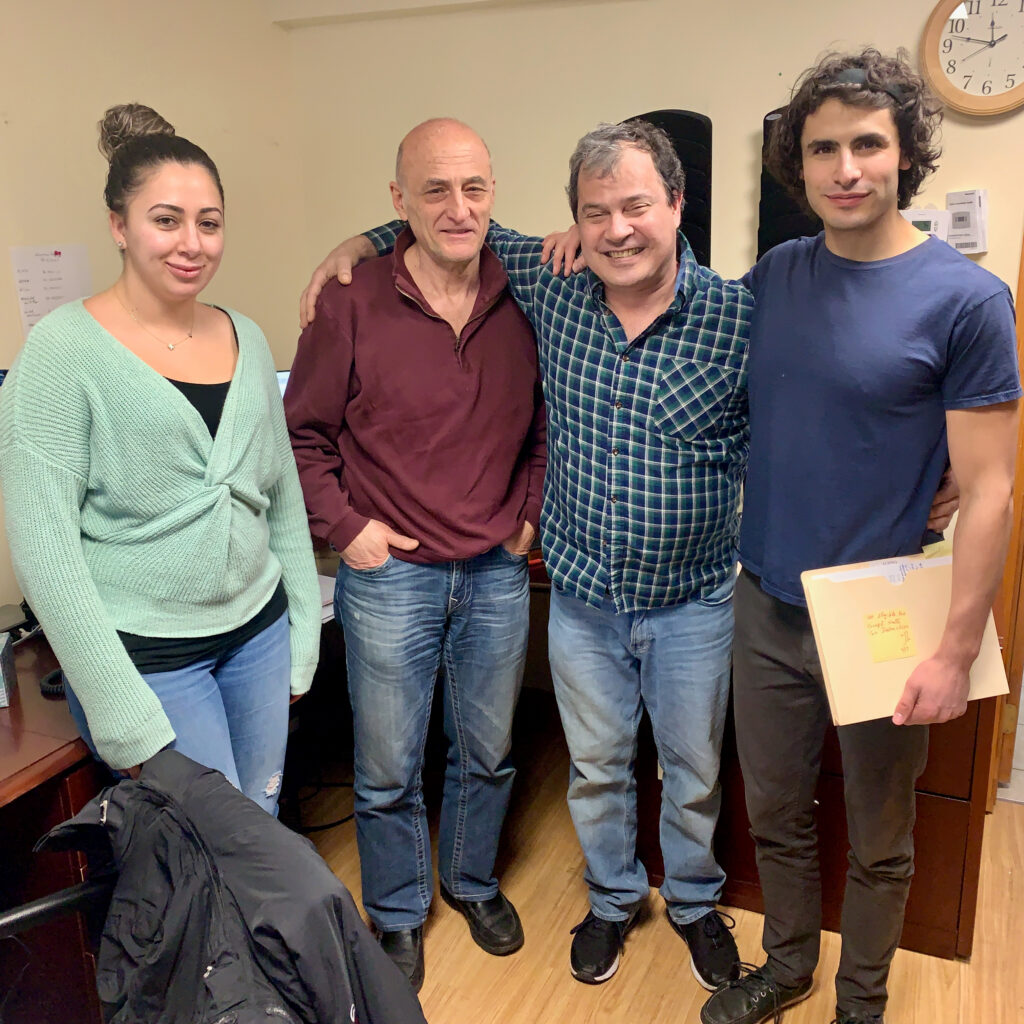
I believe that the tax work, and the social connections with his clients, contributed significantly to his survival.
And there was constantly some new grandchild to be born, just a few months away. And this gave him reason to hang on, too.
Sadly, he will not meet my third daughter, who will be born later this summer.
Who knows?
In this article, I proposed some non-traditional approaches my dad took in treating his glioblastoma. I suggested that maybe they contributed to his extended survival.
But I also want to remain humble and admit that I truly don’t know whether they did or didn’t. It’s entirely possible that none of it mattered, and that my dad’s life was in God’s hands the entire time.